How to Verify Land Ownership in Kenya Before You Buy: A Step-by-Step Guide for 2026
A
Abdihakin Elmi

Land fraud is one of the most persistent problems in Kenyan real estate. Every year, Kenyans lose billions of shillings to fraudulent land transactions — double sales, forged title deeds, squatter occupation, and government land sold by private individuals. The good news is that the verification tools to protect yourself exist. The bad news is that most buyers skip them because they trust the seller.
This guide walks you through every step of verifying land ownership in Kenya before you hand over a single shilling.
---
## Why Land Verification Cannot Be Skipped
Unlike buying a phone or a car, land transactions in Kenya involve multiple government registries, historical encumbrances, and informal occupation that will not appear in any single document. A title deed that looks perfect on the surface can carry:
- A **court order restricting transfer** registered at the land registry
- **Unpaid land rent or rates** that transfer to the new owner
- **A prior sale** where a different buyer has already paid but not yet received the title
- **Government reservation** that makes the land undevelopable despite being titled
- **Boundary disputes** with adjacent landowners that will require costly litigation
The Land Registration Act, 2012 and the Land Act, 2012 together provide a framework that protects registered owners — but only if you become the properly registered owner. If you pay without proper registration, you may have a contract but not a legal title.
---
## Step 1: Obtain a Copy of the Title Deed
Ask the seller to provide the original title deed. In Kenya, title deeds take several forms depending on when the land was registered and under what act:
- **Certificate of Lease** — for government leasehold land (most common in urban areas)
- **Certificate of Title** — for freeholds registered under the Registration of Titles Act (older titles, being converted)
- **Title Deed** — the standard document under the Land Registration Act, 2012
Examine the title for:
- The land reference (LR) number, parcel number, or plot number
- The registered owner's full name and identification details
- Any encumbrances noted on the face of the document (mortgages, cautions, restrictions)
- The issuing land registry and date of issue
**Red flag:** A title that has been laminated, has unclear text, shows signs of alteration, or has unusual staple marks may be a forgery. Originals are printed on security paper with specific watermarks.
---
## Step 2: Conduct a Land Search at the Land Registry
This is the single most important step in the entire process. A land search (officially a "historical search" or "official search") queries the government's land register and returns the current status of the title.
**How to do it:**
1. Go to the relevant Land Registry (the registry covering the area where the land sits)
2. Fill in a search form with the LR number or title number
3. Pay the search fee (currently KES 500 for a standard search)
4. Receive the official search results, typically within 2–3 working days (or same day at some registries)
**What the search reveals:**
- Current registered owner's name
- Any registered cautions, restrictions, caveats, or court orders
- Any registered mortgages or charges against the title
- History of previous transactions
**Important:** The search must be done at the specific land registry — not online, not through a third party. If someone gives you a photocopy of a search result, it is worthless. Obtain the original, stamped document yourself or through your own advocate.
For rural land (outside urban areas), the relevant registry may be at the county level. For Konza area land, searches are conducted at the Machakos Land Registry.
---
## Step 3: Confirm the Identity of the Registered Owner
The registered owner on the title must match the person selling to you. This sounds obvious, but fraud frequently occurs when:
- A seller holds a **general power of attorney** from the actual owner — verify the PoA is genuine, recently executed, and not revoked
- The seller claims the owner is **deceased** and they are the administrator of the estate — verify the grant of letters of administration or probate from the High Court
- The land is registered in a **company name** — verify at the Business Registration Service that the company is active and that the person signing has authority to sell
Always request a copy of the seller's national ID or passport and compare the name exactly against the title.
---
## Step 4: Verify Survey/Beacon Status
A title deed confirms legal ownership. A survey plan confirms what you are actually buying on the ground.
**What to check:**
- Obtain the survey plan (also called a "registry index map extract" or RIM) for the parcel. This shows the exact boundaries of the plot on a map.
- Visit the site with the survey plan and physically confirm the beacons (metal rods or concrete markers) at the four corners of the plot
- If beacons are missing, engage a licensed surveyor to re-establish them before purchase
**Why this matters:** Two adjacent plots can share a disputed boundary. Sellers sometimes misrepresent which plot is which, especially in subdivisions where plots look identical on the ground but have different values based on road frontage or corner positioning.
---
## Step 5: Check for Government Land and Public Land Reservations
Not all titled land is freely developable. Some land carries planning conditions, reservations for public purposes, or restrictions on the type of structures that can be built.
**How to check:**
1. **Physical Planning Department** at the county level — ask for the planning classification of the area (residential, commercial, agricultural, conservation area, etc.)
2. **National Environment Management Authority (NEMA)** — if the land is near a river, wetland, or protected area, it may fall within a buffer zone
3. **Kenya Urban Roads Authority (KURA) or Kenya National Highways Authority (KeNHA)** — if the plot is adjacent to a road, confirm there is no road reserve or road widening project that will reduce the plot area
For Konza corridor land, also check with the Konza Technopolis Development Authority (KoTDA) to confirm the plot is outside the Konza City master plan boundary and does not fall within a reserved zone.
---
## Step 6: Verify Rates and Land Rent Clearance
Outstanding land rent (payable to the National Land Commission for leasehold titles) and land rates (payable to the county government) transfer to the new owner upon purchase.
**How to check:**
- **Land rent clearance certificate** — obtain from the National Land Commission (NLC) or county land offices
- **Rate clearance certificate** — obtain from the county government where the land is located
Both certificates confirm that no outstanding amounts are owed. Sellers are generally required to provide these as part of the conveyancing process, but you should independently verify rather than accepting what the seller presents.
---
## Step 7: Engage a Registered Advocate
All land conveyancing in Kenya must be handled by an advocate (lawyer) admitted to the bar in Kenya. Using an advocate is not optional — it is a legal requirement for the formal transfer of title.
Your advocate will:
- Conduct or supervise the land search
- Prepare or review the sale agreement
- Prepare the transfer documents
- Calculate and facilitate payment of stamp duty (4% of value in urban areas, 2% outside urban areas)
- Lodge the transfer documents at the land registry for registration
**Never use the seller's advocate.** The seller's advocate owes a duty to the seller, not to you. Engage your own independent advocate — the cost is typically 1–2% of the purchase price and is non-negotiable for your protection.
---
## Step 8: Conduct a Physical Visit Before Signing Anything
Documents can be forged. The land itself cannot lie. Before you sign any agreement or pay any deposit:
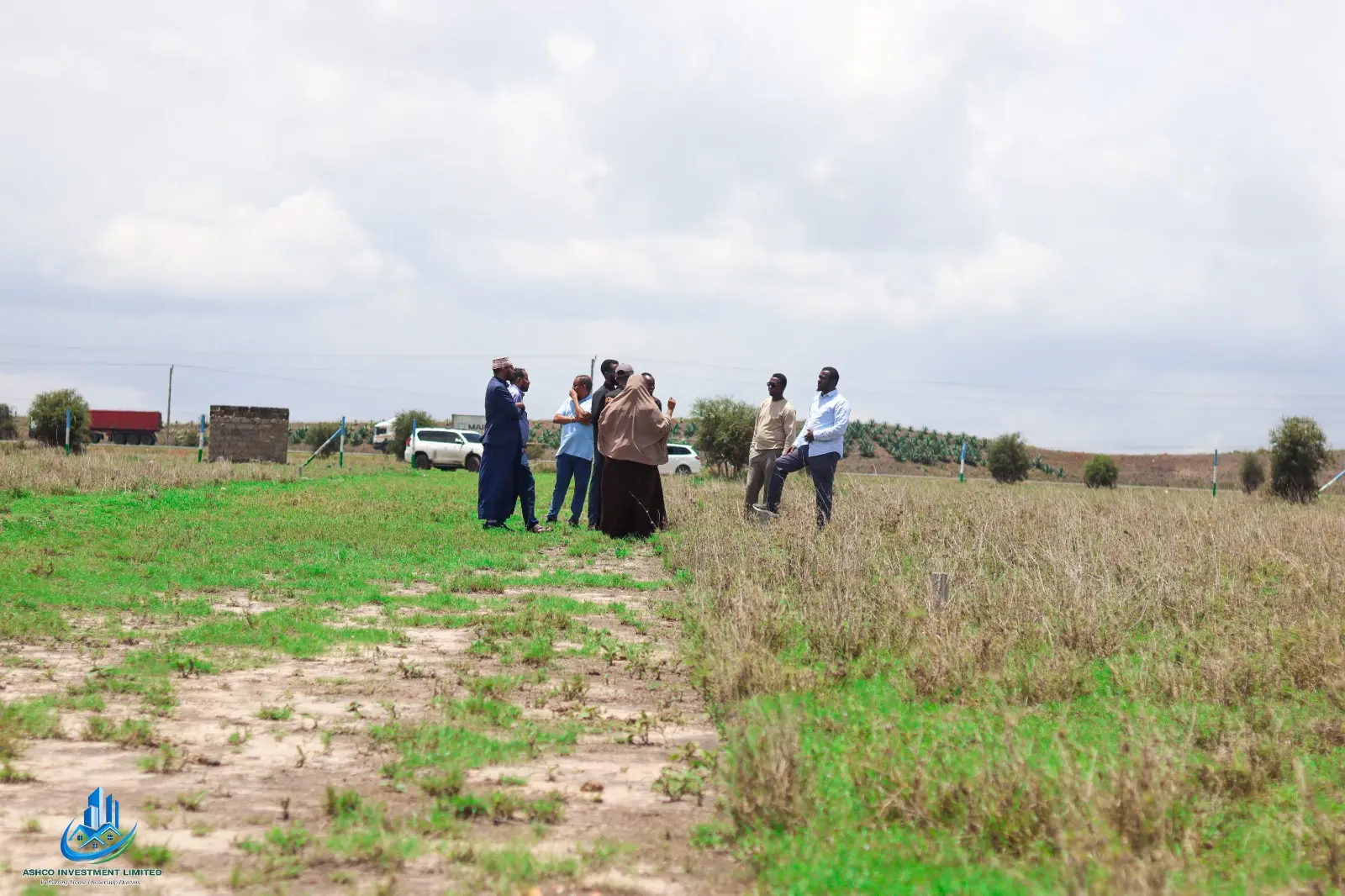
1. **Visit the site in person** — confirm the plot exists, is accessible, and matches the description
2. **Talk to neighbours** — ask if they know who owns the adjacent land, if there are any disputes, and whether anyone else has been shown or sold the same plot recently
3. **Check occupation** — is anyone living on or farming the land? Even with a title, evicting an established occupant can be legally complex
4. **Photograph the beacons and surroundings** — with GPS-tagged photos if possible, for your records
---
## Common Scams and How to Spot Them
**The "urgent seller" scam:** A seller pressures you to close quickly because "another buyer is coming tomorrow." Legitimate sellers do not need you to skip due diligence. Any pressure to rush verification is a red flag.
**The photocopied title:** A scammer shows you a colour photocopy or laminated copy of a title. Originals have security features. Never base a purchase on photocopies.
**The double sale:** The seller simultaneously sells to multiple buyers. Your protection is completing registration before others — which is why timely engagement of your advocate matters.
**The "agent commission" trick:** A middleman collects a deposit as "booking fee" or "agent commission" with a promise to arrange the seller. If no seller subsequently appears, the money is gone. Never pay unless you have met the actual registered owner.
**The beaconing fraud:** The seller shows you beacons that belong to a different, better-located plot while the title refers to a less desirable one. Always cross-reference beacons with the survey plan and GPS coordinates.
---
## A Checklist for Land Buyers in Kenya
Before you sign anything, confirm you have:
- [ ] Seen the original title deed (not a photocopy)
- [ ] Conducted an official land search at the relevant registry yourself
- [ ] Verified the seller's identity matches the registered owner
- [ ] Visited the site and confirmed beacons
- [ ] Obtained a survey plan and confirmed boundaries
- [ ] Checked planning classification with the county
- [ ] Confirmed no government reservation (road reserve, buffer zone, KoTDA boundary)
- [ ] Obtained rate and land rent clearance certificates
- [ ] Engaged your own independent advocate
- [ ] Confirmed no cautions, restrictions, or court orders on the title
If any one of these boxes cannot be ticked, do not proceed until it is resolved.
---
## What to Do If You Discover a Problem After Buying
If you have already purchased land and later discover an issue:
1. **Engage your advocate immediately** — they can register a caution to prevent further transactions while the dispute is resolved
2. **File a complaint at the National Land Commission (NLC)** — the NLC has a mandate to investigate land disputes and fraud
3. **Report to the Directorate of Criminal Investigations (DCI)** — land fraud is a criminal offence under the Land Registration Act
4. **Approach the Environment and Land Court** — this specialised court handles land disputes and can grant injunctions, cancel fraudulent titles, and award compensation
Time is critical. The longer you wait, the more complex the dispute becomes — especially if a fraudster has already on-sold the land to an innocent third party.
---
*Ashco Investment Limited conducts full due diligence on every property in its portfolio, providing buyers with official search results, survey plans, and clear title documentation before any transaction is completed. [Learn more about our properties](/properties) or [speak to our legal team](/contact).*
Free Consultation
Interested in a plot near Konza?
Leave your details and our team will call you within 24 hours with available plots and prices. No obligation.